
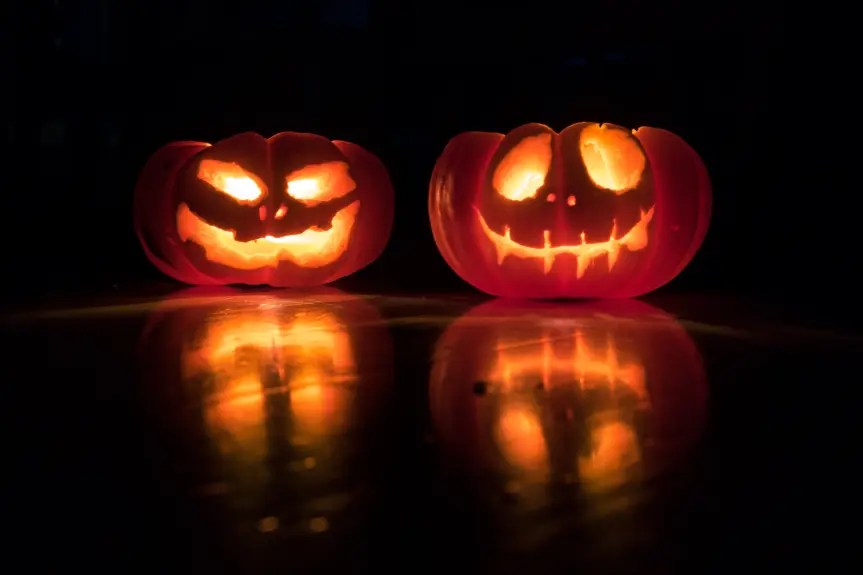
That Time of Year is Upon Us…

Scripture mentions nothing about celebrating Halloween. In fact, there are specific Holy Days (holidays) we are to observe which are outlined in the book. Halloween isn’t included in the list. Why is that and why are Christians determined to celebrate it each year?
The scripture mentions to stay away from pagan imitation, there are numerous commandments to do so. Would Halloween be categorized as pagan imitation, or is it just a fun cos-play like, treat getting time to let our hair down? Let’s take a look.
History of Halloween:
Halloween is always celebrated on the last day of October of the Gregorian calendar – October 31st. According to History.com, its original name is Samhain originating from the Celtics. People would dress in costumes and hold bonfires to ward off evil spirits.
In the same web-article, Pope Gregory III (Gregorian calendar creator) designated November 1st as All Saints Day where the evening before was considered All Hollows Eve. Then, the two were blended into one celebration – Halloween. The article explains more.
A following section of the article gets into the Roman/Celtic history. “By 43 A.D., the Roman Empire had conquered the majority of Celtic territory. In the course of the 400 years that they ruled the Celtic lands, two festivals of Roman origin were combined with the traditional Celtic celebration of Samhain.”
Notice the date, 43 A.D.. This is soon after the crucifixion of Jesus. Christianity had not spread very far during this time. So, it’s possibly unlikely the Celtics in Ireland knew much, if any, about Jesus. However, the Romans knew all too well about Judaism and Christianity. The first century Jewish Revolt was upon them, and they were already having to handle small rebellions within their territory in the Middle East. However, the Romans had their own similar celebration:
“The first was Feralia, a day in late October when the Romans traditionally commemorated the passing of the dead. The second was a day to honor Pomona, the Roman goddess of fruit and trees. The symbol of Pomona is the apple, and the incorporation of this celebration into Samhain probably explains the tradition of bobbing for apples that is practiced today on Halloween.“
In 609 A.D., “Pope Boniface IV dedicated the Pantheon in Rome in honor of all Christian martyrs, and the Catholic feast of All Martyrs Day was established in the Western church.“
See where this is going? I’ll let the article tell the rest:
“By the 9th century, the influence of Christianity had spread into Celtic lands, where it gradually blended with and supplanted older Celtic rites. In 1000 A.D., the church made November 2 All Souls’ Day, a day to honor the dead. It’s widely believed today that the church was attempting to replace the Celtic festival of the dead with a related, church-sanctioned holiday.“
“All Souls’ Day was celebrated similarly to Samhain, with big bonfires, parades and dressing up in costumes as saints, angels and devils. The All Saints’ Day celebration was also called All-hallows or All-hallowmas (from Middle English Alholowmesse meaning All Saints’ Day) and the night before it, the traditional night of Samhain in the Celtic religion, began to be called All-Hallows Eve and, eventually, Halloween.“
Then, it came to America: (The Puritans tried to keep it away)
“The celebration of Halloween was extremely limited in colonial New England because of the rigid Protestant belief systems there. Halloween was much more common in Maryland and the southern colonies.“
It didn’t work.
“As the beliefs and customs of different European ethnic groups and the American Indians meshed, a distinctly American version of Halloween began to emerge. The first celebrations included “play parties,” which were public events held to celebrate the harvest. Neighbors would share stories of the dead, tell each other’s fortunes, dance and sing.“
It’s here for good: “In the second half of the 19th century, America was flooded with new immigrants. These new immigrants, especially the millions of Irish fleeing the Irish Potato Famine, helped to popularize the celebration of Halloween nationally.“
So, if the Celtics and Romans were pagan, what do you suppose we do? The answer is obvious. Do not celebrate halloween.
What does scripture say?
In my book’s pagan imitation section of chapter 4 – The Word of God, it lists several commandments to stay away from such activities. Just to name a few:
- Do not employ omens
- There shall not be a person among you who:
- Purges his son or daughter with fire
- Uses divination
- Deals with omens
- A sorcerer using magic spells and charms
- Do not attach to enchanters
- Has a divining spirit
- Observes signs
- Questions the dead
- Do not defile yourself in your land for the dead
Seems like Halloween induces the imitations of such actions, if not the actual rituals. This is not good for the Christian.
The Struggle:
I used to love halloween. It was a fun time to dress up, grab some candy to binge until my stomach hurt, and let loose with friends. As I grew, I hit up every costume contest I could find, just for a few extra bucks. It really was my favorite holiday.
Then, I started learning more as I began this journey (which started with holidays). Then, I tried rationalizing it with what I wanted to do. “Oh it’s a time to fool the devil,” “Oh I’m just going to give the devil a run for his money,” and I love this one: “I’m just dressing up for fun.” Yeah… that’s not how it works.
As time went on, I became too busy to celebrate like I used to. It became part of my trade with themed events -safe place for the kiddos to trick-or-treat. I realized I started rationalizing it with work obligations, too. Feeling forced into the commercialization of it because, that’s a part of my industry.
Then, the pandemic hit. My small business was thrown into a whirlwind and practically shutdown without much help from the virtual transition – which included having to cancel a halloween themed event on Halloween. My trade is millennia old. It doesn’t ever do well online, but we tried.
Things started turning around for the better. We started to open back up, but I saw a demand for something in October. I found a date – and it wasn’t halloween this time. It was a success! I finished my research project and published the book before our event. I knew better this time. I never mentioned or even hinted about halloween in advertising. Nobody even noticed. I had one participant put out candy in a halloween bucket – that’s ok! My business didn’t do it nor spearhead the idea this year.
So, it’s easy to fall into the trap. We must be careful because the climb out of the trap is hard. We have internal conflict to manage and many times even external conflict.
What to do:
However, we’re to be pleasing to God, not to man. We are told in scripture that we will have worldly struggles as we walk in God’s Ways. It goes against the world and that’s the point. Jesus says we cannot serve two gods. We must choose. Choosing God, our creator, means letting go and not choosing man’s tradition which are mostly pagan in origin. Getting past our internal struggle by sticking to scripture above all else makes a life devoted to God even more rewarding!
Get the Book!
Learn more about God and Jesus Christ by ordering your copy of “For God So Loved The World: The Way, The Truth, and The Life” today!
 Living Clean Naturally